
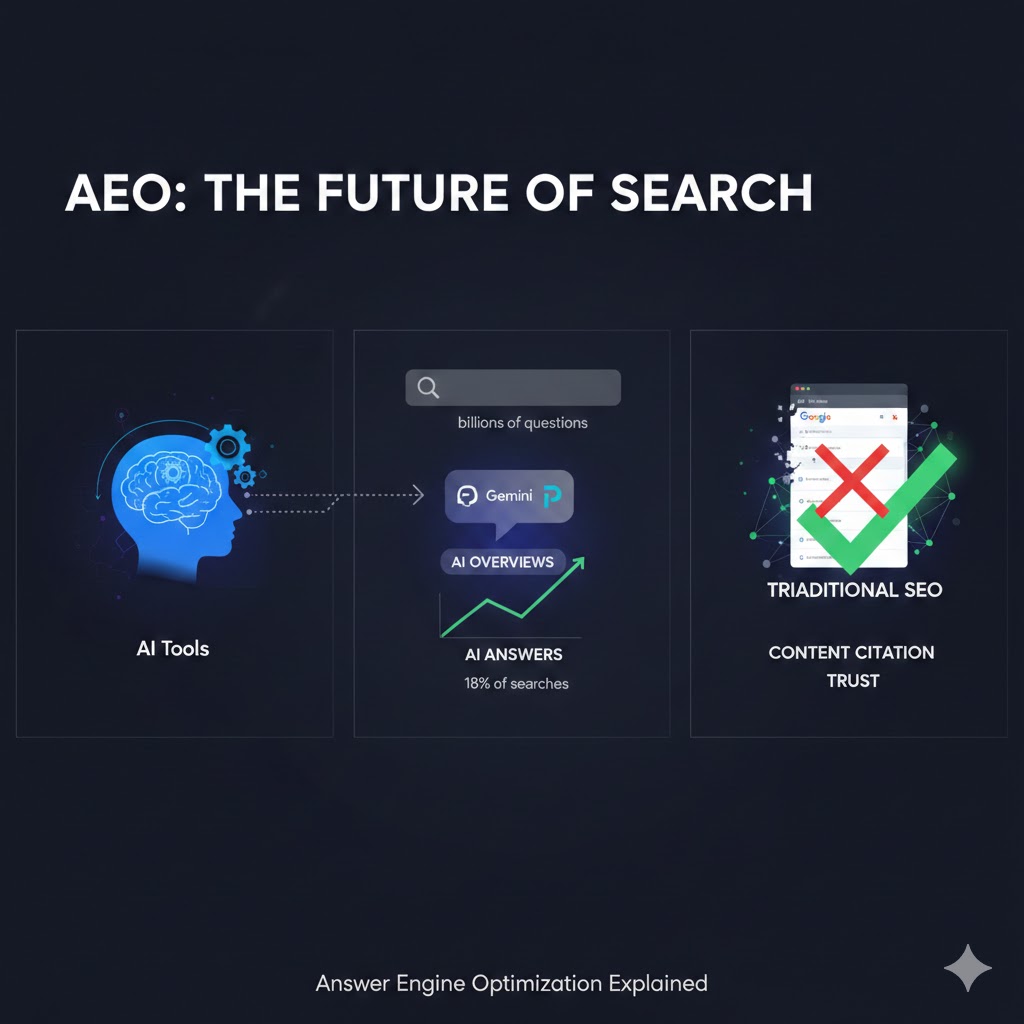
The way people search online is changing fast. AI tools like ChatGPT, Google’s AI Overviews, and Perplexity now answer billions of questions every month. This means traditional SEO strategies alone aren’t enough anymore. This guide shows you what Answer Engine Optimization (AEO) is all about, with real examples and advice from industry experts.
What Is AEO and Why Does It Matter?
Answer Engine Optimization is about getting your content featured in AI-generated answers. Instead of just trying to rank first on Google’s search results page, you now need to make sure AI tools pick your content when they answer people’s questions.
Here’s what’s happening: AI summaries now show up in about 18% of all searches. When they do, regular search results get 30% fewer clicks (Source: BrightEdge – One Year Into Google AI Overviews). But here’s the good news—when your brand appears in these AI answers, people often trust you more and engage better with your content.
What Leading SEO Experts Are Saying
It’s Just Good SEO Evolving
Greg Boser has been doing SEO since 1996. He thinks we don’t need a whole new discipline called AEO. Instead, he says it’s just SEO growing up. His advice? Think of the “E” in SEO as standing for “Experience” instead of “Engine.” The goal is still the same: understand how people look for information and help them find it (Source: WebmasterWorld Discussion on AEO).
Many SEO experts agree with this view. They say that AEO tactics are really just good SEO practices updated for AI. Things like clear content structure, direct answers, trusted sources, and proper formatting have always mattered. AI just makes these basics even more important.
Don’t Believe the Hype
Harpreet Singh Chatha from Harps Digital warns against falling for AEO myths. He says some people are trying to sell “chunk optimization” as something new and special, but it’s really just writing good content. He challenges anyone claiming AEO is completely different from SEO to name 25 things that are unique to AEO—most people can’t (Source: LinkedIn – Harpreet Singh Chatha on AEO Myths).
This healthy skepticism is important. It stops marketers from throwing away what works in favor of unproven tactics that just have new names.
Adapt Your Strategy for AI Search
Kipp Bodnar and Kieran Flanagan from HubSpot have a different take. On their podcast “Marketing Against the Grain,” they explain how AI search in Chrome and Google’s Gemini changes everything. People now ask complicated questions and get complete answers without clicking any links (Source: HubSpot – Marketing Against the Grain Podcast).
Their main point: ranking number one doesn’t guarantee people will see you anymore. But if AI tools quote your content in their answers, you win. The strategy isn’t to stop doing SEO—it’s to make your SEO work for AI tools too.
Three Simple Rules for AEO Success
HubSpot and top digital marketing agencies have found three basic principles that help AI tools choose your content (Source: HubSpot Blog – Answer Engine Optimization):
Keep Your Information Consistent means saying the same thing everywhere. AI tools check multiple sources before they trust information. When your facts, data, and company details match across your website, social media, reviews, and news mentions, AI tools see you as reliable.
Offer Something New is about providing value that doesn’t already exist online. This includes original research, your own data, expert opinions, and real case studies. AI prefers sources that add fresh insights instead of just repeating what’s already out there.
Make It Easy to Read means organizing your content so computers can understand it. Use clear headings, FAQ sections, simple tables, and logical flow. The easier you make it for AI to read and understand your content, the more likely it will use it in answers.
Real-World Success Stories
How a Software Company Got Visible in ChatGPT
A financial planning software company had a problem. They ranked well on Google, but when people asked ChatGPT or other AI tools to recommend software for mid-sized companies, their product never came up.
The team from Powered by Search found the issue: the website used fancy marketing words that sounded good to humans, but AI tools couldn’t understand what the software actually did. They rewrote the pages to answer specific questions about real situations instead of using vague promises. Within three weeks, the software started appearing in AI answers (Source: Powered by Search – AEO in 2025).
The lesson: AI tools prefer specific solutions over flashy claims. Write about concrete details and real use cases.
Equipment Supplier Gets Better Customers from AI
Netpeak USA worked with an equipment supplier and noticed something interesting. Product pages that included “Use Cases” sections got 90% of their traffic from AI tools. Even better, 5% of this AI traffic turned into customers, compared to only 4% from regular Google searches.
The company decided to add more detailed use case content to other product pages. This shows that people coming from AI answers often know exactly what they want and are more ready to buy (Source: SE Ranking – Top GEO & AEO Agency Campaigns of 2025).
Therapy Practice Wins with Voice Search
A therapy practice in Phoenix had a challenge. They used Squarespace for their website, which isn’t the best platform for SEO. They needed to show up when people asked voice assistants like Google Assistant for therapy help.
The team built a custom blog that search engines could easily read and added local SEO strategies. Even though Squarespace has limitations, the smart content structure helped them appear in voice search results when people in Phoenix asked about therapy services (Source: SE Ranking – Top GEO & AEO Agency Campaigns of 2025).
Bookkeeping Firm Targets ChatGPT Users
EcomBalance provides bookkeeping for e-commerce businesses. They wanted to show up where startup founders actually ask questions—inside ChatGPT and other AI tools. TrioSEO helped them create a plan to get mentioned in AI answers.
It wasn’t easy. The bookkeeping industry has big competitors with strong brands, and Google ads cost over $20 per click. The strategy was to create detailed, expert content that directly answered the questions e-commerce founders ask. This made EcomBalance a source that AI tools could trust and quote (Source: TrioSEO – How We Got Ranking in ChatGPT for EcomBalance).
How to Track Your AEO Results
Regular SEO metrics like rankings and click rates don’t tell the whole AEO story. Here’s what to track instead:
How often you’re quoted means counting how many times AI tools mention your brand or content when answering questions. You’ll need to manually test this across different AI platforms or use special tracking tools.
Your share compared to competitors shows how often you appear versus other companies in AI answers about your industry.
Visibility without clicks tracks when your information reaches people through AI summaries or featured snippets, even if they don’t visit your website.
Quality of AI-referred visitors looks at whether people who first find you through AI citations behave differently or convert better than regular search visitors.
Simple Ways to Start with AEO
Write Clear, Direct Answers
Put your main answer at the start of each section. AI tools often use the first complete answer they find. Use headings that match how people actually ask questions. Create FAQ pages that answer common questions in everyday language.
Add Structured Data
Use schema markup to help AI understand what your content is about. This includes:
- FAQ schema for question-and-answer content
- HowTo schema for step-by-step guides
- Article schema to show publication details
- Local Business schema for location-based searches
- Organization schema for company information
Build Trust Signals
Show why people should trust you. Add detailed author bios with credentials. Link to reliable sources and research. Keep your business information the same everywhere online. Get mentioned in trusted industry websites.
Cover Topics Thoroughly
Create complete guides on important topics with supporting articles. This shows AI tools you’re an expert. Link related content together to help AI understand how different pieces connect.
Mistakes to Avoid
Don’t just focus on keywords while ignoring what your content actually means. AI needs to understand the purpose of your content, not just match words.
Don’t create thin, shallow content just to rank for specific phrases. AI looks for valuable, unique information it can actually use.
Keep your facts consistent everywhere. If your business details are different on your website, Google, and social media, AI tools get confused.
Don’t ignore technical basics like fast loading speeds, mobile-friendly design, and easy crawling. If AI can’t access your content easily, it won’t use it.
Don’t forget about review sites, social media, and other platforms. AI checks multiple places to verify information about your brand.
Combine AEO with Your SEO
Most successful businesses don’t replace their SEO with AEO—they combine them. Good technical SEO helps AI find and read your content. Traditional SEO builds the trust and relevance that AI checks before quoting you. AEO techniques then make your content easier for AI to extract and use.
This combined approach makes sense because search engines and AI tools are merging. Google now includes AI summaries in regular search results. ChatGPT pulls information from Google searches when creating answers. The lines are blurring, so you need one unified strategy.
What’s Coming Next
AI-powered search is growing fast, not slowing down. Over 400 million people use OpenAI products every week (Source: TechCrunch – OpenAI now serves 400M users every week). Google keeps expanding where AI summaries appear. Voice assistants handle billions of questions. The message is clear: more searches will end with AI answers instead of website clicks.
For businesses, this is both a challenge and an opportunity. Companies that adapt early get noticed where customers are actually looking for solutions. Companies that wait risk becoming invisible, even if their Google rankings stay strong.
How to Get Started
First, check where your brand shows up in AI answers right now. Try asking relevant questions in ChatGPT, Google AI Overviews, Perplexity, and voice assistants. Write down which competitors appear and why their content gets chosen.
Find the most important questions your potential customers ask when looking for solutions like yours. Make sure your content directly answers these questions with specific details, not general marketing talk.
Make basic technical improvements. Add schema markup where relevant, use clear headings in your content, create helpful FAQ sections, and make sure your business information is the same everywhere.
Track both traditional metrics and new AEO measurements. Check how often you’re quoted, test AI visibility regularly, and see if visitors from AI sources behave differently.
The search world keeps changing, but one thing stays the same: provide real value to people looking for answers. AI tools are just new ways to connect questions with expertise. If you organize your knowledge to help both humans and AI understand it, you’ll succeed in this new era of search.
Ready to optimize your content for AI-powered discovery? Speak with a digital marketing specialist to develop an integrated SEO and AEO strategy that ensures visibility across traditional search and answer engines alike.